
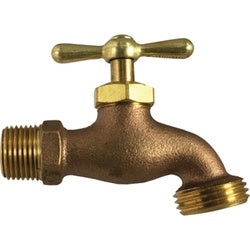
Hose Bibbs / Sillcocks
Hose Bibbs & Sillcocks — Frost-Proof, Anti-Siphon, Lead-Free Brass
Frost-proof sillcocks and anti-siphon hose bibbs in lead-free brass from Legend and Red-White. In stock at PVFPro with fast shipping from multiple U.S. warehouses.
What Is a Hose Bibb?
A hose bibb is the threaded outdoor faucet a garden hose screws onto; a sillcock is the wall-penetration version — the valve body extends through the wall so the working parts sit inside the heated building. The frost-proof sillcock shuts the water off at the warm end of that extension, so nothing full of water is left outside to freeze and burst in winter. PVFPro stocks hose bibbs and sillcocks from Legend Valve and Red-White Valve in lead-free brass.
Why Anti-Siphon Protection Matters
A plain hose bibb is a cross-connection risk: a hose left in a puddle, a chemical sprayer, or a clogged drain can siphon contaminated water back into the potable supply. Anti-siphon hose bibbs carry a vacuum breaker that admits air when pressure drops, breaking the siphon. Plumbing codes require this protection on outdoor hose connections — when replacing old plain bibbs on a commercial property, anti-siphon models are the compliant choice.
Applications
- Commercial building exteriors — loading docks, service yards, and utility areas
- Multi-family and institutional properties with code-required anti-siphon protection
- Frost-proof wall hydrant installations in freeze climates
- Hose connection points for groundskeeping and washdown duty
- Boiler and mechanical room hose connections (see also boiler drains)
How to Choose the Right Hose Bibb or Sillcock
- Frost-proof or not. In any freeze climate, a frost-proof sillcock empties its barrel on shutoff — worth the few extra dollars every time.
- Anti-siphon for potable compliance. Choose models with integral vacuum-breaker protection for code-compliant hose connections.
- Match the wall thickness. Sillcocks come in different extension lengths; measure the wall before ordering so the operating end lands inside the heated space.
- Quarter-turn vs multi-turn. Quarter-turn hose bibbs cycle fast and resist packing wear; multi-turn models remain common and economical.
- Connection size. Standard hose thread outlets with FNPT or sweat inlets by series — match your supply piping.
Technical Specifications Overview
- Materials: Lead-free brass bodies, by series.
- Outlets: Standard garden-hose thread outlets.
- Inlets stocked: Threaded and sweat connections depending on series.
- Protection: Anti-siphon vacuum breaker protection on compliant models.
- Certification: Lead-free series carry NSF/ANSI 61 and 372 listings — confirm per product page.
- Brands stocked: Legend Valve and Red-White Valve Corp.
Winterizing and Year-Round Maintenance
Frost-proof sillcocks are built to drain — the installation has to let them. Mount with a slight downward pitch to the outside so the barrel empties at shutoff, and always disconnect hoses before freezing weather: a hose left attached traps water at the valve and defeats the whole design. Before winter, shut off and drain the supply to exterior hose bibbs where an interior isolation valve exists, then leave the bibb open to drain. In season, the drips that show up are usually the seat washer on multi-turn models or a worn packing — both are bench repairs, and both are the difference between a five-minute fix and a wall penetration. On commercial properties, walk the exterior bibbs annually: loose mounting, missing vacuum-breaker caps, and seized handles are cheap to catch in summer and expensive to discover in a January freeze.
Frequently Asked Questions
- Why does my frost-proof sillcock still freeze? Almost always an installation angle problem — the barrel must pitch down and outward so it drains on shutoff. Installed sloping inward, it holds water and splits on the first hard freeze.
- Can I repair instead of replace? Frost-proof sillcocks have replaceable seats and packing in most series — a worn seat washer is the common leak fix and does not require opening the wall.
- Do hose bibbs need vacuum breakers on commercial jobs? Yes — codes require anti-siphon protection on hose connections, and inspectors look for it. Anti-siphon models are stocked for that reason.
- What is the difference between a hose bibb and a boiler drain? Same valve idea, different station: hose bibbs mount outdoors for hose service; boiler drains are the drain cock at water heaters and boilers.
Why Buy from PVFPro
- In stock — fast shipping from multiple U.S. warehouses
- Frost-proof, anti-siphon, quarter-turn, and multi-turn models in one place
- Real specification data on every product page
- Contractor pricing with bulk discounts available
Supply House Counter Notes
When replacing an old sillcock, pull the old one first and measure the wall — extension lengths vary by series, and guessing wrong leaves the shutoff end outside the heated wall where it can still freeze. On retrofit work, take the chance to add an interior isolation valve ahead of the sillcock if there is not one: the future freeze break gets repaired from inside the building instead of through an exterior wall. Brass trim caps and mounting hardware are worth a few extra dollars on visible commercial exteriors. And when a customer complains of a "leaking sillcock," check whether the water is actually coming past the vacuum breaker — anti-siphon devices discharge on shutoff by design, and a dry discharge port gets misread as a valve leak.


