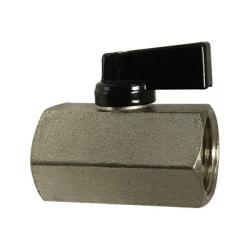
Mini Ball Valves — Compact Brass Shutoff for Tight Spaces
Mini ball valves in compact lead-free brass bodies — quarter-turn shutoff for instrument lines, equipment drops, and tight enclosures. In stock at PVFPro with fast U.S. shipping.
What Is a Mini Ball Valve?
A mini ball valve is a compact quarter-turn shutoff in a small-body package — the same brass ball, PTFE seat, and blow-out proof stem engineering as a full-size ball valve, sized for instrument lines, equipment drops, and tight enclosures. Anywhere a standard valve body will not fit — dispenser cabinets, filter housings, radiator takeoffs, appliance connections — the mini valve provides real, positive shutoff where a needle valve or stop would have been the compromise.
Applications
- Instrument and gauge isolation on small lines
- Equipment and appliance connections in tight enclosures
- Branch and fixture drops where a standard body is oversized
- Water filter and treatment equipment shutoff
- Radiant and hydronic branch isolation at manifolds
- Any low-clearance installation where handle swing is limited
How to Choose a Mini Ball Valve
-
Lead-free brass for potable contact. The lead-free series carry NSF/ANSI 61 and 372 listings — confirm on the product page.
-
Match the end connections. FNPT x FNPT, MNPT x FNPT, and other thread combinations are stocked by series — order the orientation that matches your piping.
-
Check the handle swing. The reason for going mini is clearance; verify the lever rotation fits the enclosure.
-
Verify pressure and temperature. Mini valves carry meaningful ratings but check the rating block against your service conditions.
-
Do not undersize for the sake of compactness. Match the line size; a reducer-body valve defeats the flow you are trying to keep.
Technical Specifications Overview
-
Materials: Lead-free brass bodies with chrome-plated balls and PTFE seats, by series.
-
Connections: Threaded NPT combinations by series.
-
Operation: Quarter-turn lever handle.
-
Features by series: Full port bodies and blow-out proof stems on stocked models — see each product page.
-
Certification: Lead-free series certified to NSF/ANSI 61 and 372 — confirm per product page.
-
Brands stocked: Legend Valve.
Where Mini Valves Win Over Alternatives
The compact valve market has three players: mini ball valves, needle valves, and angle stops. Needle valves meter; they are for regulating flow, not slamming it closed daily, and their fine seats hate debris. Angle stops are fixture valves — right under a sink, but rarely the right choice for equipment and instrument lines. The mini ball valve splits the difference: real quarter-turn ball sealing in a body small enough for gauge snubbers, filter housings, and appliance guts. Choose it where you need positive, fast, repeatable shutoff in a small envelope and where the handle can turn. Skip it where you need to modulate flow — a ball does not modulate, it seats. And in any enclosure with an access panel, mount the valve so the handle parks parallel to the panel face when closed; future-you will appreciate the clearance when the panel only opens so far.
Frequently Asked Questions
-
Are mini ball valves rated like full-size valves? Stocked series carry solid working-pressure ratings for their size — always check the rating block on the product page for your service conditions.
-
Mini valve or needle valve for instruments? Ball valves for on/off isolation, needle valves for metering. Mini ball valves seal positive and cycle fast — the standard for gauge and equipment isolation.
-
What sizes do mini valves come in? Small line sizes from 1/4" through 1/2" are typical — see the variants on each product page.
-
Can I use them on compressed air? Check the media suitability and rating on the product page; within their pressure and temperature ratings, many contractors use them for pneumatic isolation. Verify per series.
Why Buy from PVFPro
- In stock — fast shipping from multiple U.S. warehouses
- Compact shutoff for tight spaces with real spec data on every page
- Contractor pricing with bulk discounts available
- Built for pros, not DIY
Supply House Counter Notes
Mini valves live or die by thread prep. The bodies are small brass — a pipe wrench and enthusiasm strip them; use the right size wrench on the flats, sealant sparingly, and hold the valve body steady so torque lands on the fittings, not the valve. On gauge installations, put the mini valve between the isolation point and the gauge so the gauge can be changed without a system shutdown. In filter and treatment equipment, spec the valve at line size — undersizing to "save space" chokes the service flow the equipment was sized for. And buy them by the box: mini valves are consumables in service work, the price is right in bulk, and the truck that carries them wins the tight-access jobs. Keep a box of the common thread combinations in service stock — they are the fastest fix on the truck.
Related Collections


 Legend Valve 101-540

 Legend Valve 101-340